

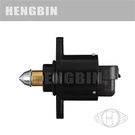
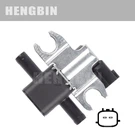

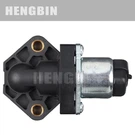

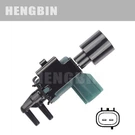
Hey there! As a supplier of carbon canister solenoid valves for BYD, I've been getting a lot of questions lately about how these valves handle fuel vapor under high - temperature conditions. So, in this blog, I'm gonna break it all down for you.
First off, let's talk about what a carbon canister solenoid valve does. It's a crucial part of a car's evaporative emissions control system. Its main job is to regulate the flow of fuel vapor from the carbon canister to the engine's intake manifold. The carbon canister stores fuel vapor that would otherwise escape into the atmosphere, and the solenoid valve controls when and how much of this vapor gets sent back into the engine to be burned.
Now, high - temperature conditions can really throw a wrench into things. When it's hot outside, the fuel in the tank evaporates more quickly. This means there's a higher volume of fuel vapor that needs to be managed. If the carbon canister solenoid valve can't handle this increased vapor flow, it can lead to a bunch of problems. For example, excess fuel vapor might leak into the atmosphere, causing pollution and potentially triggering the car's check engine light.
So, how does the carbon canister solenoid valve for BYD handle this challenge? Well, BYD's solenoid valves are designed with some pretty smart features.
One of the key features is the use of high - quality materials. The valve body is made from heat - resistant plastics and metals that can withstand the high temperatures without deforming or losing their functionality. This ensures that the valve can operate smoothly even when things get hot under the hood.
The solenoid itself is also engineered to work efficiently in high - temperature environments. It has a special coating that helps to dissipate heat and prevent overheating. This coating is designed to maintain the solenoid's magnetic properties, which are essential for opening and closing the valve at the right times.
Another important aspect is the valve's control system. BYD's carbon canister solenoid valves are connected to the car's engine control unit (ECU). The ECU monitors various parameters, such as engine temperature, fuel level, and ambient temperature. Based on this information, it adjusts the operation of the solenoid valve to optimize the flow of fuel vapor. For example, when the temperature is high and there's more fuel vapor, the ECU might open the valve more frequently or for longer periods to ensure that all the vapor is properly managed.
Let's take a closer look at how this all works in real - world scenarios. Imagine it's a scorching summer day, and you're driving your BYD car. The fuel in the tank is evaporating rapidly due to the high temperature. The carbon canister is filling up with fuel vapor, and the ECU senses this. It then sends a signal to the solenoid valve to open more often. The valve opens, allowing the fuel vapor to flow from the canister to the intake manifold, where it's mixed with air and burned in the engine. This not only prevents the vapor from escaping into the atmosphere but also helps to improve the car's fuel efficiency.
Now, I know you might be thinking, "That sounds great, but how does BYD's valve compare to others on the market?" Well, I've got some links here to other carbon canister solenoid valves for different car models. Check out these valves: Carbon Canister Solenoid Valve'0280142459 Suitable for Various Car Models Such As Volkswagen, Carbon Tank Solenoid Valve 12582167 Is Suitable for Various Models Such As Buick, and Carbon Tank Solenoid Valve 28596988 Suitable for Various Models Such As Delphi. While these valves are suitable for different makes and models, BYD's valve is specifically designed to work in harmony with BYD's engines and emission control systems. It's been tested and optimized to handle the unique requirements of BYD cars, especially under high - temperature conditions.
In addition to the design features, BYD also conducts extensive testing on its carbon canister solenoid valves. These valves are tested in simulated high - temperature environments to ensure that they can perform reliably over a long period. The testing includes checking for things like valve opening and closing times, flow rates, and durability. This rigorous testing process helps to ensure that every valve that leaves the factory meets the highest standards of quality and performance.


If you're a car manufacturer or a parts distributor looking for a reliable carbon canister solenoid valve for BYD cars, you've come to the right place. Our valves are not only high - quality but also competitively priced. We understand the importance of providing a product that can handle the toughest conditions, and we're confident that our carbon canister solenoid valves for BYD are up to the task.
Whether you're dealing with the sweltering heat of summer or the extreme temperatures in a desert climate, our valves will keep your BYD cars running smoothly and cleanly. So, if you're interested in learning more or want to start a procurement discussion, don't hesitate to reach out. We're here to help you find the best solution for your needs.
In conclusion, the carbon canister solenoid valve for BYD is a well - engineered component that can effectively handle fuel vapor under high - temperature conditions. Its use of high - quality materials, advanced control systems, and thorough testing make it a reliable choice for BYD cars. If you're in the market for these valves, give us a chance to show you what we can offer.
References:
- Automotive Emission Control Systems: Principles and Practice by John Heywood
- Handbook of Automotive Power Electronics and Motor Drives by Ali Emadi